 21:38Oldies Music · 1966 · Greatest Hits by Year
Forgotten Hits of 1967 You Forgot You Knew
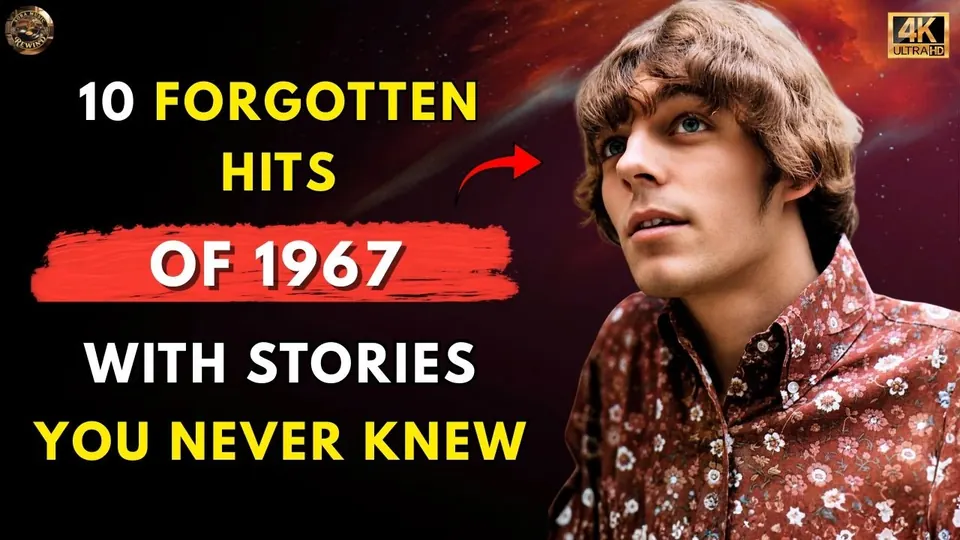
Episode: Top 10 Forgotten Hits of 1967 You Forgot You Knew
From Sora Music Rewind · 20 min ·This episode plays on YouTube — the button opens it in a new tab.
About These Forgotten Hits of 1967
The forgotten hits of 1967 are the songs many of us can still hum in a few notes, even if the names of the singers slipped away long ago. Plenty of them climbed into the Top 10.
This episode counts down ten of them, from #10 to #1. The chart positions and stories below were checked against chart records, and a few details from the video have been corrected.
Which Forgotten Hits of 1967 Made the List
#10: Georgy Girl — The Seekers (1967)
This was the title song of the British film Georgy Girl. Tom Springfield, brother of Dusty Springfield, wrote the music, and actor Jim Dale wrote the words. The singers were the Seekers, a folk group from Melbourne, Australia.
The version heard in the film uses noticeably different lyrics from the record most people bought. In early 1967 the single reached No. 2 on the Billboard Hot 100, held off the top by the Monkees' "I'm a Believer." It went all the way to No. 1 on the Cash Box chart and in Australia.
The song was nominated for the Academy Award for Best Original Song but lost to "Born Free." At the ceremony, it was performed by Mitzi Gaynor rather than by the Seekers.
#9: Incense and Peppermints — Strawberry Alarm Clock (1967)
This song grew from an instrumental idea by band members Mark Weitz and Ed King, though the writing credit went to John Carter and Tim Gilbert. It first appeared as a B-side, tucked behind a single the group released under an earlier name, Thee Sixpence.
The lead voice did not belong to a band member at all. Greg Munford, a teenage friend from another group, was at the session, and producer Frank Slay chose him to sing lead. Munford later said he was 16 at the time, and he never joined the band.
Radio stations around Los Angeles began playing the B-side instead of the A-side, and Uni Records picked it up for national release. It reached No. 1 on the Billboard Hot 100 for the week ending November 25, 1967, and earned a gold record. In 1997, Austin Powers: International Man of Mystery brought it to a new generation.
#8: Kind of a Drag — The Buckinghams (1967)
Chicago songwriter Jim Holvay, who was playing with a local group called the Mob, wrote this one. The Buckinghams recorded it for the small Chicago label USA Records.
That bright horn section was arranged by Frank Tesinsky, and it became the sound the group was known for. The record reached No. 1 on the Billboard Hot 100 in February 1967 and stayed there for two weeks.
Soon after, the band signed with Columbia Records, and James William Guercio became their producer. Guercio later carried that "brass rock" idea further with Blood, Sweat & Tears and the band Chicago.
#7: 98.6 — Keith (1967)
Keith was the stage name of James Barry Keefer, born in Philadelphia in 1949. His song took its title from normal human body temperature.
Released late in 1966, "98.6" reached No. 7 on the Billboard Hot 100 in early 1967.
His run was cut short when U.S. Army officials arrested him for draft evasion during a concert tour. He later recalled that his main job in the service was making coffee for generals. In 1974 he joined Frank Zappa's touring band, and he later worked in television.
#6: Snoopy vs. the Red Baron — The Royal Guardsmen (1966)
Dick Holler first wrote this song in 1962 as "The Red Baron," and by his account it sat unreleased for about three years. Producer Phil Gernhard then added two verses about Snoopy, the Peanuts beagle who imagined himself as a World War I flying ace.
The Royal Guardsmen, a group from Ocala, Florida, recorded it at a studio in Tampa. Released in November 1966, it reached No. 2 on the Hot 100 for the week of December 31, 1966, and stayed popular well into 1967.
Nobody had asked Charles Schulz for permission to use Snoopy's name. Schulz and United Feature Syndicate sued, and the publishing money from the song went to the syndicate. The two sides made peace, though: Schulz let the group record more Snoopy songs and drew the artwork for their 1967 album Snoopy and His Friends.
#5: The Rain, the Park and Other Things — The Cowsills (1967)
The Cowsills began in 1965 when brothers Bill, Bob and Barry started performing together in Newport, Rhode Island. Their mother, Barbara, joined in 1967, and their sister, Susan, soon followed.
Artie Kornfeld and Steve Duboff wrote this gentle song about a girl with flowers in her hair. With Bill singing lead, it reached No. 2 on the Billboard Hot 100 in December 1967, kept from the top by another Monkees hit, "Daydream Believer." The family's image later helped inspire the TV series The Partridge Family.
Behind the scenes, life was harder. The 2010 documentary Family Band: The Cowsills Story described their father's controlling and abusive behavior. Barbara, Barry, Bill and Richard Cowsill have since passed away.
#4: Bend Me, Shape Me — The American Breed (1967)
Scott English and Larry Weiss wrote this song, and it had already been recorded in 1966, including a version by the Outsiders. The American Breed, a band from the Chicago area, released their version in December 1967.
The single mix was sped up slightly during mastering, which gave it extra drive. It reached No. 5 on the Billboard Hot 100 in early 1968, the band's only Top 10 hit.
Scott English later co-wrote "Brandy," which Barry Manilow turned into "Mandy." And several American Breed members went on to form a new band that became Rufus. In 1972, a young singer named Chaka Khan joined them.
#3: Then You Can Tell Me Goodbye — The Casinos (1967)
John D. Loudermilk wrote this ballad. Country singer Don Cherry released it first in 1962, and Johnny Nash recorded it in 1964. Gene Hughes of the Casinos, a vocal group from Cincinnati, heard Nash's version on Nashville radio station WLAC.
The group recorded it at King Studios in Cincinnati. They were there to cut an instrumental for a disc jockey, and they used the time left over to record this song.
Their doo-wop version reached No. 6 on the Billboard Hot 100 in March 1967, the group's only Top 40 hit. In 1968, Eddy Arnold took it to No. 1 on the country chart.
#2: Little Bit O' Soul — The Music Explosion (1967)
British songwriters John Carter and Ken Lewis wrote this song, and a Coventry band called the Little Darlings released it in 1965 without much success.
The Music Explosion came from Mansfield, Ohio. Producers Jerry Kasenetz and Jeffry Katz signed them, and their version was released in April 1967.
It reached No. 2 on the Billboard Hot 100 and was certified gold for a million copies sold.
#1: Come On Down to My Boat — Every Mother's Son (1967)
Jerry Goldstein and Wes Farrell wrote this song. A group called the Rare Breed released it first in 1966 as "Come and Take a Ride in My Boat," and it went nowhere.
Every Mother's Son grew out of brothers Lary and Dennis Larden, a folk duo who met keyboard player Bruce Milner at a Greenwich Village nightclub in 1966. Their version reached No. 6 on the Billboard Hot 100 in July 1967, their only Top 40 hit.
In 1987, a pirate station broadcasting from a ship off New York, Radio Newyork International, chose it as its first musical selection. Federal authorities soon raided the ship and shut the station down. As for Milner, he went on to become a dentist.
Why These 1967 Songs Slipped From Memory
Most of these records were one big moment for the people who made them. A teenager sang lead and went back to his own band. A Chicago group handed its sound to a producer who built bigger bands with it. A keyboard player traded the stage for a dental office.
The songs never really left, though. They kept turning up on oldies radio long after the names behind them faded.
Which of these forgotten hits of 1967 can you still sing along to, and where were you when you first heard it?
Sources and Further Reading
Topics in This Story
Your turn...
Which song takes you right back — and where were you when you first heard it?
Tell us the story — fellow fans would love to hear it.
We check every fact — but if you spot a mistake, we'd love to know.Report a correction →
More Greatest Hits by Year Stories
21:38Oldies Music · 1966 · Greatest Hits by Year 25:16Oldies Music · 1969 · Greatest Hits by Year
1969 Songs With Secrets Even Fans Don't Know
 20:56Oldies Music · 1976 · Greatest Hits by Year